Picking the right Furnace Mesh Belt isn't just about flipping through a equipment catalog — it's about really understanding how it works. A belt that does great in one furnace might not hold up at all in another. Things like temperature, the atmosphere inside the furnace, the load you're carrying, the shape of your products, and how fast the conveyor runs all play a role in how long your belt lasts. Honestly, those small details can make a big difference.
So, start with knowing the operating temperature and how your heating ramps up and down. Stainless steels like 304, 310, or 314 might seem similar, but choosing the right one really depends on exactly how long the belt will be exposed to those conditions and what kind of atmosphere it’ll be in. The way the belt is woven, wire thickness, and how big the openings are all affect how strong it is, how well air can circulate, and how well it supports your product. For instance, a finer mesh can give more stability but might also trap more residue and need more frequent cleaning — a little detail worth keeping in mind.
Don’t forget to look at the whole system — think about belt tension, sprocket setup, edge design, the width of your furnace, and how easy it is to reach for maintenance. When talking to suppliers, ask for official material certificates, case studies, or test results; don’t just take their word for it. A good manufacturer will explain how the belt performs during heating, cooling, loading, and all those cycles we run every day. But keep in mind, even the best advice has its limits. Sometimes real-world conditions throw curveballs that lab tests don’t catch. It’s often smarter to do a quick trial run before committing to a big order.
After a few cycles, take a good look at the belt. Check for any warping, stretched links, cracks at welds, scaling, or uneven movement. Note what you see — this info can really help you fine-tune your specifications later. Remember, the cheapest belt isn’t always the best deal. Usually, stability, longer lifespan, and fewer breakdowns matter way more. Being cautious and thorough in your pick can really pay off by keeping your product quality high and ensuring the furnace runs smoothly and safely.
Define Furnace Conditions: 500–1,150°C, Atmosphere, Load, and Cycle Time
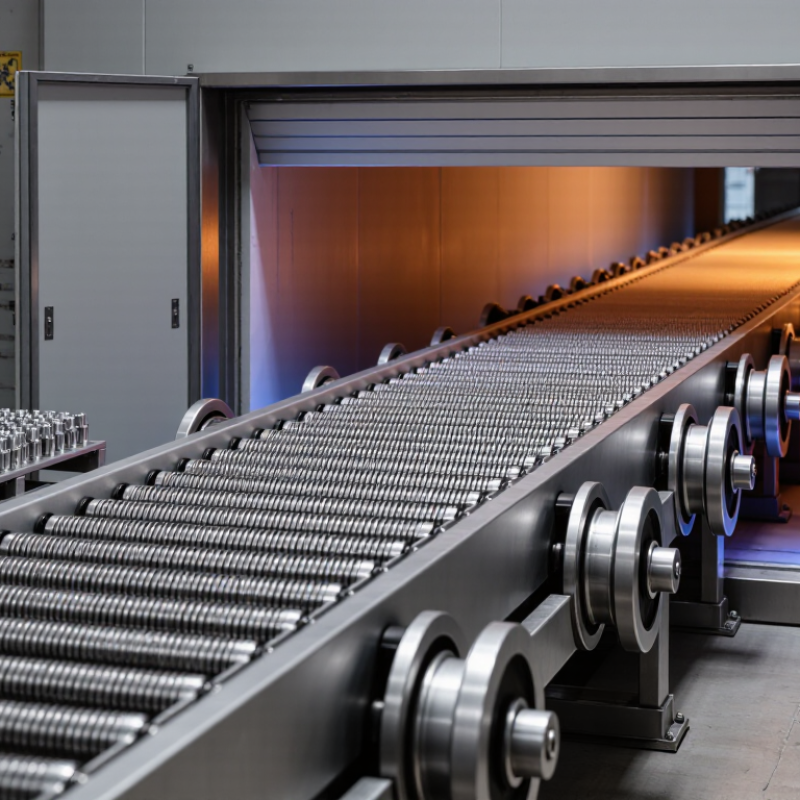
Choosing the right Furnace Mesh Belt starts with accurate furnace conditions. Record the working temperature, not only the controller setting. A process running at 500°C needs different belt strength than one reaching 1,150°C. Heat exposure also changes belt growth, sag, and surface oxidation.
Atmosphere matters just as much. Air, hydrogen-rich gas, nitrogen, vacuum, and carbon-containing mixtures affect alloy selection and belt life. Oxygen can accelerate scaling at high temperatures. Reducing atmospheres may weaken unsuitable materials. I have seen belts appear stable during short trials, then distort after repeated cycles. That result was easy to miss.
Load and cycle time complete the assessment. Measure product weight, contact area, spacing, and the force applied during loading. Heavy parts can mark the mesh or stretch its edges. Long cycles demand better resistance to creep and thermal fatigue. Check heating and cooling rates too. Rapid changes create stress at welds and connecting links. A practical test should run the actual load profile, including start-up and shutdown. The first trial may still be wrong. Review belt pitch, wire diameter, support spacing, and tracking after several cycles. Record temperature at the belt surface, because furnace air readings can mislead. Small details matter here.
How to Choose the Right Furnace Mesh Belt?
Define furnace conditions: 500–1,150°C, atmosphere, load, and cycle time
| Process | Typical Atmosphere | Typical Load | Mesh Belt Consideration |
| Stress Relieving | Air or nitrogen | 50–100 kg/m² | Prioritize load capacity and dimensional stability |
| Hardening | Endothermic gas | 40–80 kg/m² | Use a robust belt with good fatigue resistance |
| Brazing | Vacuum or nitrogen-hydrogen | 10–25 kg/m² | Select a clean, low-contamination mesh design |
| Bright Annealing | Hydrogen or nitrogen-hydrogen | 20–35 kg/m² | Consider heat resistance, surface cleanliness, and belt tracking |
The chart compares representative furnace setpoints and cycle times across common heat-treatment operations. Higher temperatures, reactive atmospheres, heavier loads, and longer cycles generally require greater belt strength, creep resistance, oxidation resistance, and careful selection of mesh opening and wire diameter. Final belt selection should be verified against the actual furnace profile, material chemistry, belt speed, and loading pattern.
Select Belt Alloys: Compare 304, 310, 314, and 330 for Heat Resistance
How to Choose the Right Furnace Mesh Belt?
Selecting the alloy starts with temperature, atmosphere, and belt load. Engineering data compiled in ASM Handbook commonly places 304 stainless steel near 870°C for continuous service, with higher intermittent exposure possible. It suits lighter heat-treatment work, but repeated cycling can accelerate scaling and distortion. Heat changes everything.
Alloy 310 generally supports service around 1,100–1,150°C, offering better oxidation resistance than 304. Alloy 314 adds higher silicon content, which can improve scale resistance during long furnace runs. Alloy 330 is often selected for carburizing or reducing atmospheres, where nickel content helps resist carburization and thermal shock. Published alloy data and ASTM A240/A240M specifications support comparing chemistry, tensile strength, and corrosion resistance, but they do not replace furnace trials.
In practical use, a 310 mesh belt may look excellent after a week, then sag under heavy fixtures. That gap matters. Belt width, wire diameter, open area, and weld quality affect real performance. A 330 belt can cost more initially, yet reduce replacement frequency in carbon-rich atmospheres. However, choosing it for a clean oxidizing furnace may be unnecessary. Measure the atmosphere, not only the temperature. Check sulfur, carbon potential, moisture, and heating cycles. My own selection process would include a small trial section, because published limits assume controlled conditions. Real furnaces rarely behave perfectly.
Match Mesh Design: Choose 0.8–3.0 mm Wire and 40–80% Open Area
How to Choose the Right Furnace Mesh Belt?
For a Mesh Belt Conveyor Furnace, wire diameter and open area directly affect heating, strength, and airflow. Select wire between 0.8 and 3.0 mm according to load weight, part size, and furnace temperature. Fine 0.8–1.2 mm wire suits small, lightweight components and improves heat exposure. Heavier products may require 2.0–3.0 mm wire for better support. However, thicker wire can reduce heating efficiency.
Open area usually ranges from 40% to 80%. A 70–80% open area encourages faster air circulation and more uniform heat transfer. It also reduces the belt’s thermal mass. Lower open areas, around 40–55%, provide stronger support for small parts that might fall through. A wider opening is not automatically better. Parts can shift, catch, or deform during movement.
Tips: Test the mesh with actual parts before production. Place sample pieces across several belt sections. Check whether edges remain stable and whether residue blocks openings. Measure belt deflection after heating, not only at room temperature. In practice, a balanced design often performs better than the lightest option. I have seen overly open mesh improve airflow but create handling problems. That trade-off deserves a second look. Keep records of belt speed, load weight, and temperature changes during trials.
Calculate Capacity: Balance kg/m² Load, Belt Speed, and Drive Torque
When choosing a Sintering Furnace Mesh Belt, begin with the real production load, not the furnace’s advertised capacity. Calculate kg/m² from the parts, trays, and spacing across the usable belt area. Multiply load density by belt width and speed to estimate throughput in kg/h. A 40 kg/m² load moving at 0.12 m/min on a 1.2 m belt gives about 346 kg/h. The arithmetic looks simple. Production rarely is.
Drive torque must cover friction, belt weight, product weight, acceleration, and hot-start resistance. Estimate belt pull, then use this formula: torque equals belt pull multiplied by drive pulley radius, divided by drive efficiency. For example, 1,200 N of belt pull, a 0.15 m pulley radius, and 85% efficiency require about 212 Nm. Add a practical safety margin for scale buildup and thermal expansion. Oversizing is safer, but it can reduce speed control and increase operating cost.
During commissioning, weigh actual trays and measure belt speed under heat. Check motor current during startup, not only during steady operation. Watch for sag between supports. A calculated load may still miss uneven product placement or temporary overloads. I have found conservative estimates useful, though they are not perfect. Recheck the figures after several production cycles, because real furnace conditions often challenge the first spreadsheet.
How to Choose the Right Furnace Mesh Belt? - Calculate Capacity: Balance kg/m² Load, Belt Speed, and Drive Torque
| Typical Application | Usable Belt Width
(m) | Distributed Load
(kg/m²) | Belt Speed
(m/min) | Calculated Capacity
(kg/h) | Estimated Belt Tension
(N) | Drive Pulley Diameter
(mm) | Estimated Drive Torque
(N·m) | Recommended Design Margin |
| Light parts and low-density products | 0.60 | 15 | 0.25 | 135 | 350 | 200 | 41 | 25% |
| General Heat Treatment of small components | 0.80 | 30 | 0.40 | 576 | 900 | 250 | 132 | 30% |
| Medium-load continuous production | 1.00 | 40 | 0.50 | 1,200 | 1,800 | 300 | 318 | 30% |
| High-load treatment of dense metal parts | 1.20 | 50 | 0.30 | 1,080 | 2,600 | 350 | 535 | 35% |
| Delicate or oxidation-sensitive products | 0.80 | 20 | 0.20 | 192 | 650 | 200 | 76 | 30% |
| Calculation Basis and Selection Checks |
| Capacity calculation | Capacity (kg/h) = Width (m) × Load (kg/m²) × Speed (m/min) × 60 |
| Drive torque estimate | Torque (N·m) = Belt Tension (N) × Pulley Radius (m) ÷ Drive Efficiency; the examples use an assumed drive efficiency of 85%. |
| Load definition | Distributed load includes the product weight over the usable belt area. The belt mass, fixtures, trays, and accumulated scale must also be included when calculating total conveyor tension. |
| Speed selection | Lower belt speed increases heating or soaking time. Higher speed increases throughput but may reduce thermal exposure and increase acceleration and drive requirements. |
| Torque verification | Select a gearbox and motor with sufficient continuous torque, starting torque, and thermal capacity. Verify the calculation against actual belt mass, furnace length, incline, friction, startup conditions, and operating temperature. |
| Engineering note: The capacity and torque values are design examples calculated from the displayed inputs. Final furnace mesh belt selection should be confirmed using the actual product loading pattern, belt construction, furnace atmosphere, operating temperature, conveyor length, pulley arrangement, and required safety factor. |
Verify Belt Dimensions: Check Width, Length, Edge Type, and Furnace Clearance
Choosing the right Continuous Mesh Belt Furnace starts with measured dimensions, not a catalog estimate. Record the usable belt width, overall frame width, and product footprint separately. Leave room for side drift, fixtures, and thermal expansion. A belt that looks adequate when cold may scrape guides after heating.
Measure the furnace length from loading point to discharge point. Then match it with required dwell time, belt speed, and production rate. Edge type matters too. A reinforced edge can protect the mesh near guides, while a simple edge may reduce weight and cost. The choice depends on load shape and side pressure.
Check the actual furnace clearance around the belt, including insulation, rollers, doors, burners, and maintenance access. Even a few millimeters can affect tracking. Less is not always better.
The U.S. Department of Energy’s Industrial Decarbonization Roadmap reports that process heating represents about 51% of onsite manufacturing energy use. Poor clearance can increase friction, heat loss, and unplanned downtime.
NFPA 86 also emphasizes safe furnace construction, spacing, and operating controls. Use these requirements with site measurements, not instead of them.
In plant inspections, I have seen teams measure belt width but forget the return path. That mistake is easy to repeat. Recheck dimensions at operating temperature, document every tolerance, and ask the belt supplier to confirm the drawing before fabrication.
Assess Durability: Review Creep, Oxidation, Tensile Strength, and Belt Life
A furnace mesh belt faces heat, load, scale, and repeated bending every shift. The U.S. Department of Energy’s Industrial Decarbonization Roadmap identifies process heating as more than half of industrial energy use. That exposure makes durability a production issue, not a minor specification.
Creep deserves careful review. ASM Handbook, Volume 19, explains that creep accelerates sharply as temperature approaches an alloy’s service limit. Ask for creep-rupture data at your actual temperature and belt tension. Tensile strength at room temperature can mislead. A belt may test strongly in the warehouse, then stretch beside a 1,000°C furnace. Test hot strength when possible. Small sag matters.
Oxidation is equally practical. ASTM G54 recommends controlled oxidation testing, while ASTM E139 supports creep testing under constant load. Compare mass gain, scale adhesion, and wire diameter loss after exposure. A 2023 furnace-maintenance report from a European heat-treatment association noted that oxidation scale and thermal cycling frequently preceded belt replacement, although operating conditions varied widely. Treat that figure cautiously. Your atmosphere may be harsher.
Track belt life by recording pitch growth, edge cracks, weld failures, and cleaning intervals. A belt that lasts twelve months but causes frequent line adjustments may be the wrong choice. In my experience, operators often review alloy chemistry first and tension second. That order deserves reconsideration. Ask for test temperatures, stress levels, exposure time, and failure photographs. Without those details, “long life” is only a promise.
Conclusion
Choosing the right Furnace Mesh Belt starts with understanding the operating environment. Define the furnace temperature, typically between 500 and 1,150°C, along with the atmosphere, product load, and cycle time. These factors determine the appropriate alloy, with options such as 304, 310, 314, and 330 offering different levels of heat resistance and service performance. The mesh design should also match the application, including wire diameters from 0.8 to 3.0 mm and an open area of approximately 40% to 80% for balanced heating, airflow, and product support.
Capacity and mechanical reliability are equally important. Calculate the required load in kg/m², belt speed, and drive torque to prevent overloading and unstable operation. Before installation, verify belt width, length, edge style, and clearance from the furnace structure. Finally, evaluate creep resistance, oxidation behavior, tensile strength, and expected belt life to select a durable solution that supports consistent production and reduces maintenance interruptions.