



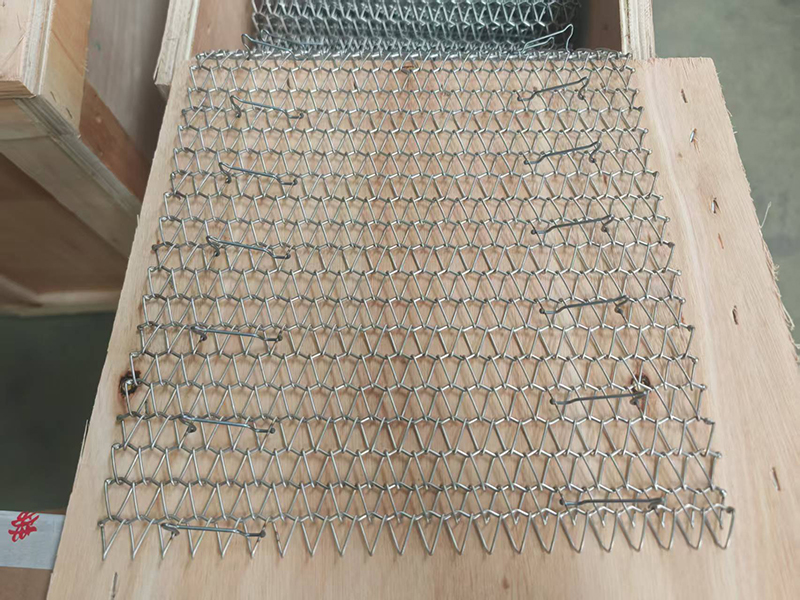


Top Factors to Consider Before Buying Furnace Belts
Choosing an unsuitable Furnace Belt can lead to premature belt stretching, thermal fatigue, camber distortion, or unexpected line stoppages. To help plant engineers and procurement teams make informed purchasing decisions, here are the most important technical factors to evaluate before ordering replacement or custom furnace belts.
1. Operating Temperature and Thermal Cycling
Operating temperature is the single most critical factor in determining furnace belt specifications. However, maximum operating temperature is only half the equation—you must also evaluate thermal cycling.
- Continuous High Heat:Continuous furnaces operating at steady temperatures (e.g., 1000℃ to 1150℃) subject the belt to constant thermal tension, making creep resistance the primary requirement.
- Thermal Cycling (Heating & Cooling): Processes where the belt repeatedly enters and exits heated zones experience aggressive thermal expansion and contraction. This cycling accelerates thermal shock and weld joint fatigue.
Matching the operating envelope with the proper alloy grade ensures the belt retains its structural integrity without premature elongation.
2. Alloy Metallurgy and Oxidation Resistance
Standard stainless steels perform well at moderate temperatures, but high-heat industrial furnaces require advanced heat-resistant alloys. Choosing the wrong metallurgy will lead to rapid surface oxidation, scaling, or carburization.
Common furnace belt alloys include:
- AISI 314 / 310S Stainless Steel:Excellent scaling resistance for temperatures up to 1050℃ - 1100℃ in oxidizing atmospheres.
- Inconel 600 / 601 (Nickel-Chromium Alloys):Superior resistance to oxidation, green rot, and carburization at elevated temperatures up to 1150℃+. Ideal for sintering and high-temperature heat treating.
- 330 Stainless Steel (Fe-Ni-Cr Alloy): Exceptional resistance to thermal shock and carburization in controlled atmosphere furnaces.
3. Weave Construction and Load Density
The mechanical weave design of the mesh belt affects air/gas circulation, load capacity, and weight distribution.
- Balanced Weave Belts:Feature alternating left- and right-hand spirals joined by crimped cross-rods. This balanced structure neutralizes belt tracking drift and remains the most versatile choice for medium-duty heat processing.
- Compound Balanced (Dense) Weave: Utilizes tightly nested spirals and multiple cross-rods per spiral. This dense weave provides a flat, smooth surface for supporting small parts, fasteners, or heavy unit loads without sagging.
- Ladder / Rod-Reinforced Weaves: Designed for extra-heavy payloads, incorporating reinforcing rods across the pitch to handle extreme tension loads without narrowing.
4. Furnace Atmosphere Compatibility
The chemical composition of your furnace atmosphere significantly impacts metal corrosion rates at high temperatures:
- Endothermic / Carburizing Atmospheres:Require high-nickel alloys (e.g., Inconel 601 or Alloy 330) to resist carbon penetration and embrittlement.
- Nitriding or Ammonia Atmospheres: Demand specialized alloys resistant to nitriding embrittlement.
- Vacuum or Inert Gas (Argon/Nitrogen):Require clean, low-outgassing alloys with stable surface oxide layers.
Always cross-reference your process gas chemistry with the mesh material manufacturer to prevent premature chemical degradation.
5. Drive Mechanism and Tracking Control
Even the highest-grade furnace belt will fail early if driven improperly. Consider how drive forces are transmitted across the belt width:
- Friction Drive Drums:Depend on precise tension adjustment and rubber/lagged drive rollers. Inaccurate alignment causes tracking drift, edge wear, or belt camber.
- Sprocket / Positive Drive Systems:Utilize chain-edge reinforcements or precision sprockets to guarantee positive tracking, reducing cross-rod deflection and side-wall friction.
Summary: Invest in Precision Thermal Engineering
Buying a furnace belt isn't just about matching dimensions; it requires balancing temperature profiles, atmospheric chemistry, mechanical loads, and alloy metallurgy to maximize belt lifespan.
At Huada Metal Mesh Belt, we manufacture custom high-temperature furnace belts, balanced weave conveyor belts, and specialized heat-resistant wire meshes tailored to demanding heat-treatment and industrial furnace applications.
To request technical datasheets, discuss custom alloy selection, or get a direct quote for your facility, visit Huada Metal Mesh Belt.